

Market Snapshot: January 2026
Summary
Constructive start to the year despite lingering uncertainty
- Economic and investment conditions remained broadly constructive in January. The month was characterised by moderating inflation, resilient labour markets, and decent corporate earnings. However, these were offset by continuing geopolitical and policy uncertainty. This uncertainty led to a much weaker US Dollar which declined against all currencies including the Australian dollar.
- Risky assets generally delivered positive returns to start 2026. Notably, market leadership has begun to broaden beyond the narrow "mega-cap" cohort that drove markets for much of the prior two years, with Emerging Markets significantly outperforming their developed peers.
- Global growth expectations for 2026 have been revised slightly higher (now a little above 3%) as disinflation progresses and financial conditions ease modestly. However, forecasters continue to flag elevated uncertainty around public debt levels and the durability of the disinflation trend.
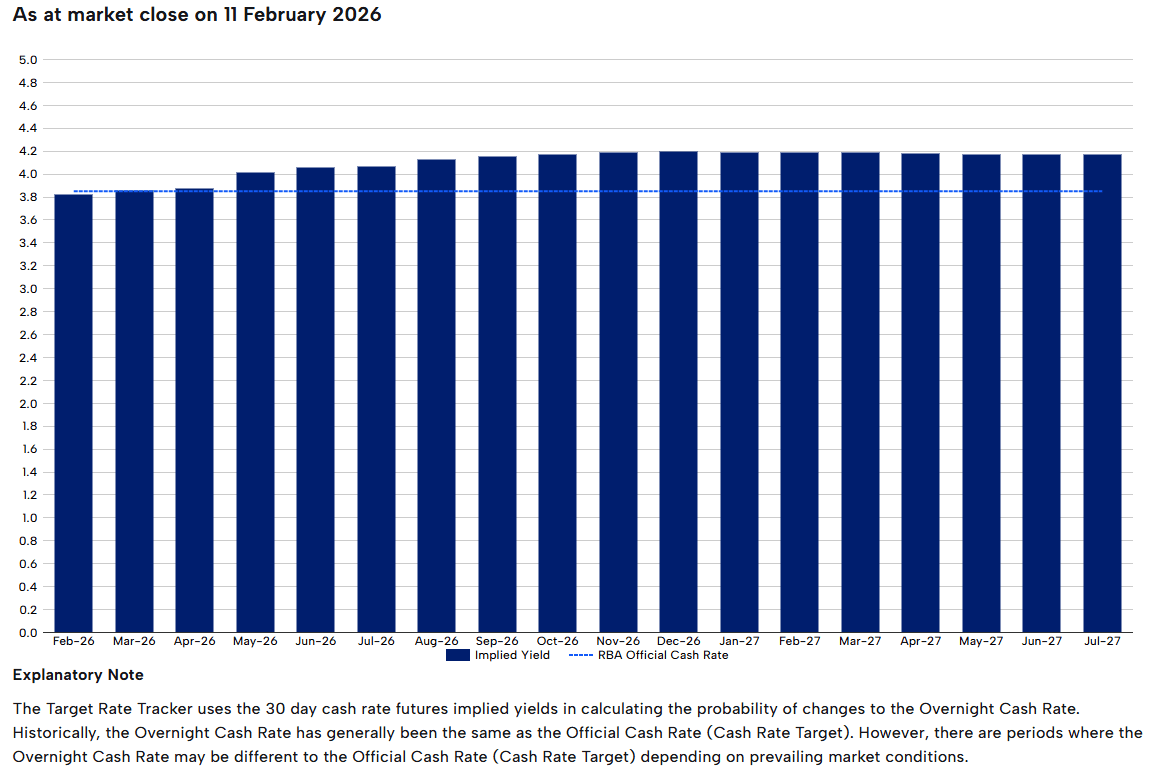
- Unfortunately, in Australia, the story is more inflationary resulting in higher cash rates generally expected by the market for 2026.
- Our core investment message remains characterised by a delicate balance between improving economics but persistent tail risks from high sharemarket valuation in USA. This means disciplined risk management rather than aggressive positioning changes. Equities continue to offer an attractive risk premium in specific markets, but returns may be challenged by greater dispersion across.
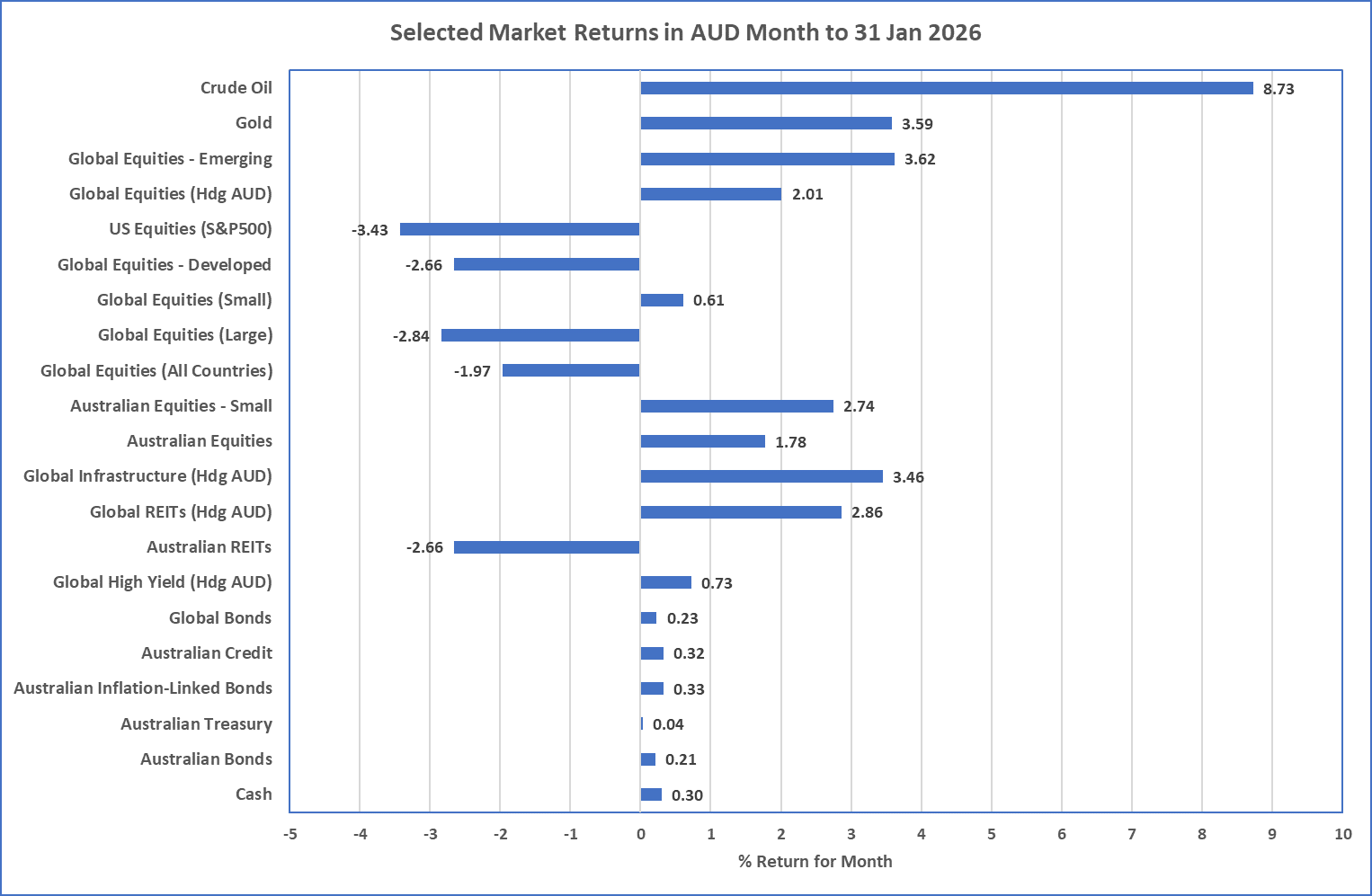
Chart 1 … A slight comeback for Australian assets
Source: Morningstar
What happened last month?
Markets & Economy … Broadening gains and shifting expectations
- Global equity markets delivered a positive start to the year, with broad indices recording modest gains. In a shift from recent trends, Emerging Markets significantly outperformed developed peers.
- Within developed markets, the United States underperformed the rest of the world but still posted a small positive return. European and Asia-Pacific markets generally fared better over the month.
- Best performing stocks continued to broaden beyond the largest US technology names. Cyclical and value exposures, small companies, and several commodity-linked sectors outperformed in January.
- Overseas fixed income markets also advanced as investors weighed the prospect of eventual policy easing against still elevated but declining inflation. Credit spreads tightened on improving risk sentiment, supporting returns across investment-grade and high-yield segments.
- Australian equities outpaced some offshore benchmarks, with the ASX 200 delivering a solid gain for the month. Best performance came from resources and financials, while local bond markets reflected shifting expectations around the timing of any Reserve Bank policy moves and higher inflation in Australian dampened local fixed interest returns.
Outlook … A data-dependent pause and a slow domestic rebalancing
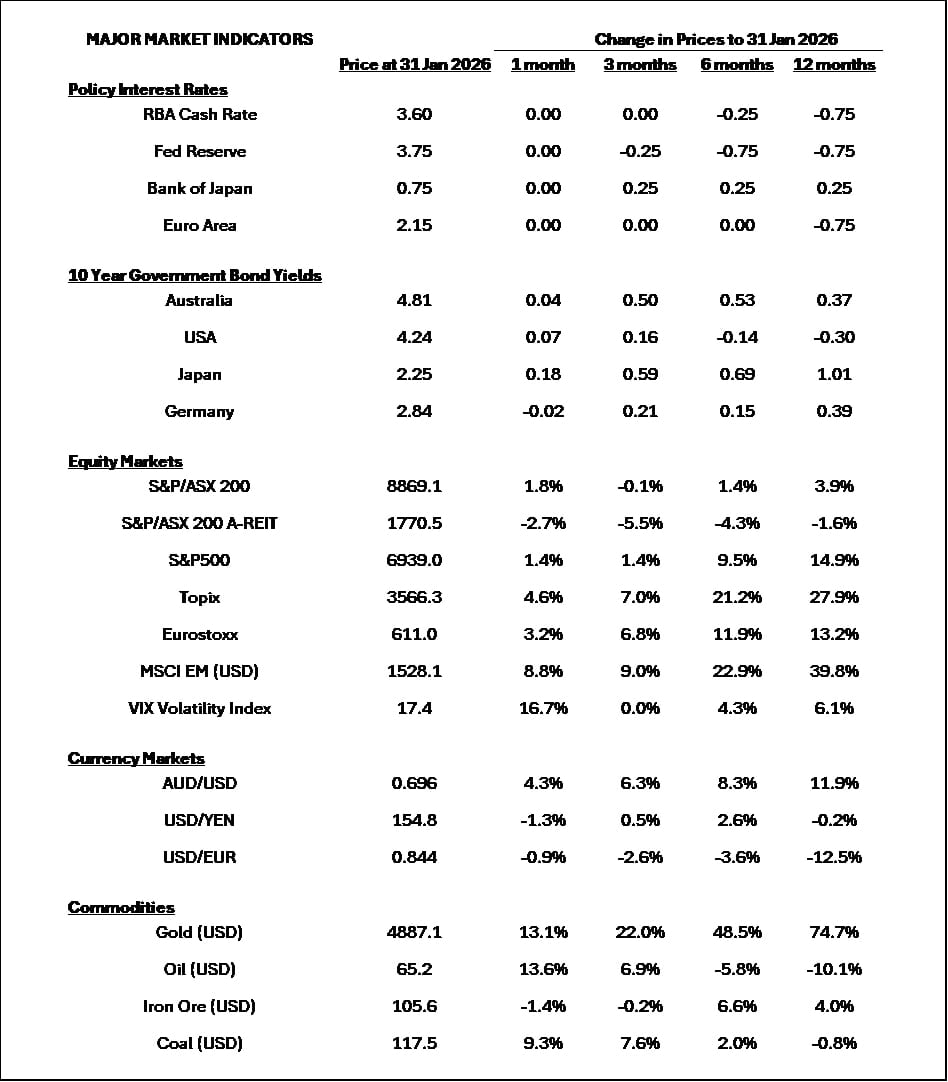
- Headline inflation across most major economies (ex-Australia) continued to drift lower through late 2025, and projections released in January reinforced expectations of further progress toward lower central bank inflation targets. While underlying inflation remains above target in many jurisdictions, the breadth of extreme price pressures has narrowed.
- Central banks have largely moved from an aggressive tightening stance (i.e. higher rates) to a more data-dependent pause. Markets are now debating the timing and extent of the first easing steps, interpreting incoming data as consistent with a "higher-for-longer, but not higher-again" policy profile.
- In Australia, the Reserve Bank remains cautious due to still-elevated core inflation and pockets of labour-market tightness. Forward guidance no longer acknowledges the next move as down, as inflation data was higher than desired.
- Domestic data paints a picture of a slowing but still expanding Australian economy. Real GDP growth is running modestly below the longer term trend, supported by public investment and population gains. Labour market indicators showed some softening, yet unemployment remains low by historical standards,
- For Australian-based portfolios, diversification continues to be essential. Maintaining a balance between domestic and global exposures—with an eye to currency risk (in the face of a weakening US Dollar) and differing monetary policy trajectories—remains a prudent approach as 2026 unfolds.
Major Market Indicators
Sources: Morningstar, Trading Economics, Reserve Bank of Australia
Market Expectations of future RBA Cash Rates
Expectations are a 4.2% cash rate by end of 2026 …
US Growth Valuation continues near double of World sharemarket valuations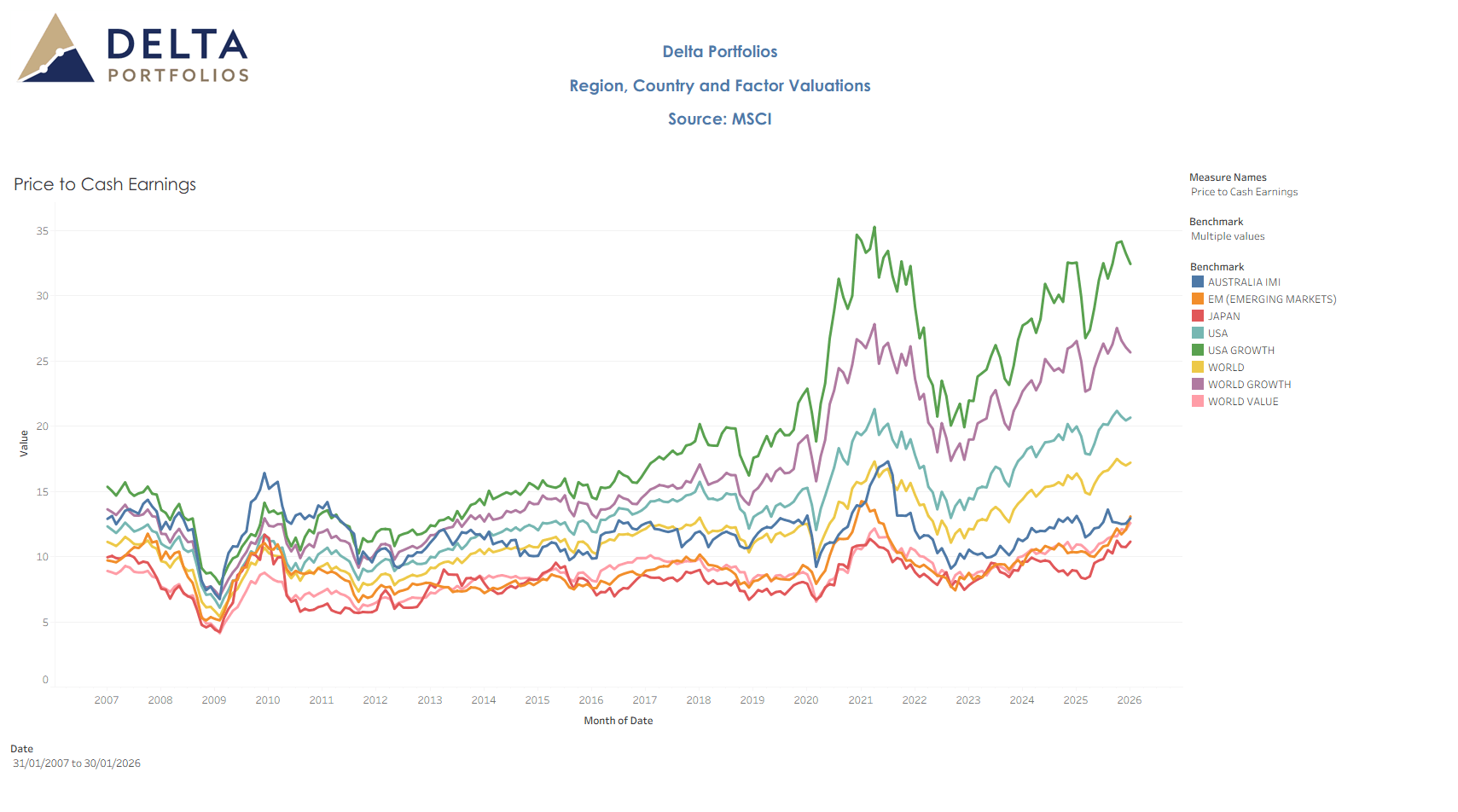
Source: Delta Research and Advisory, MSCI
McConachie Stedman Financial Planning Pty Ltd is a Corporate Authorised Representative of MCS Financial Planning Pty Ltd | ABN 11 677 710
600 | AFSL 560040
General Advice Warning
The information provided in this article is for general information purposes only and is not intended to and does not constitute formal
taxation, financial or accounting advice. McConachie Stedman does not give any guarantee, warranty or make any representation that the
information is fit for a particular purpose. As such, you should not make any investment or other financial decision in reliance upon the
information set out in this correspondence and should seek professional advice on the financial, legal and taxation implications before
making any such decisions.